


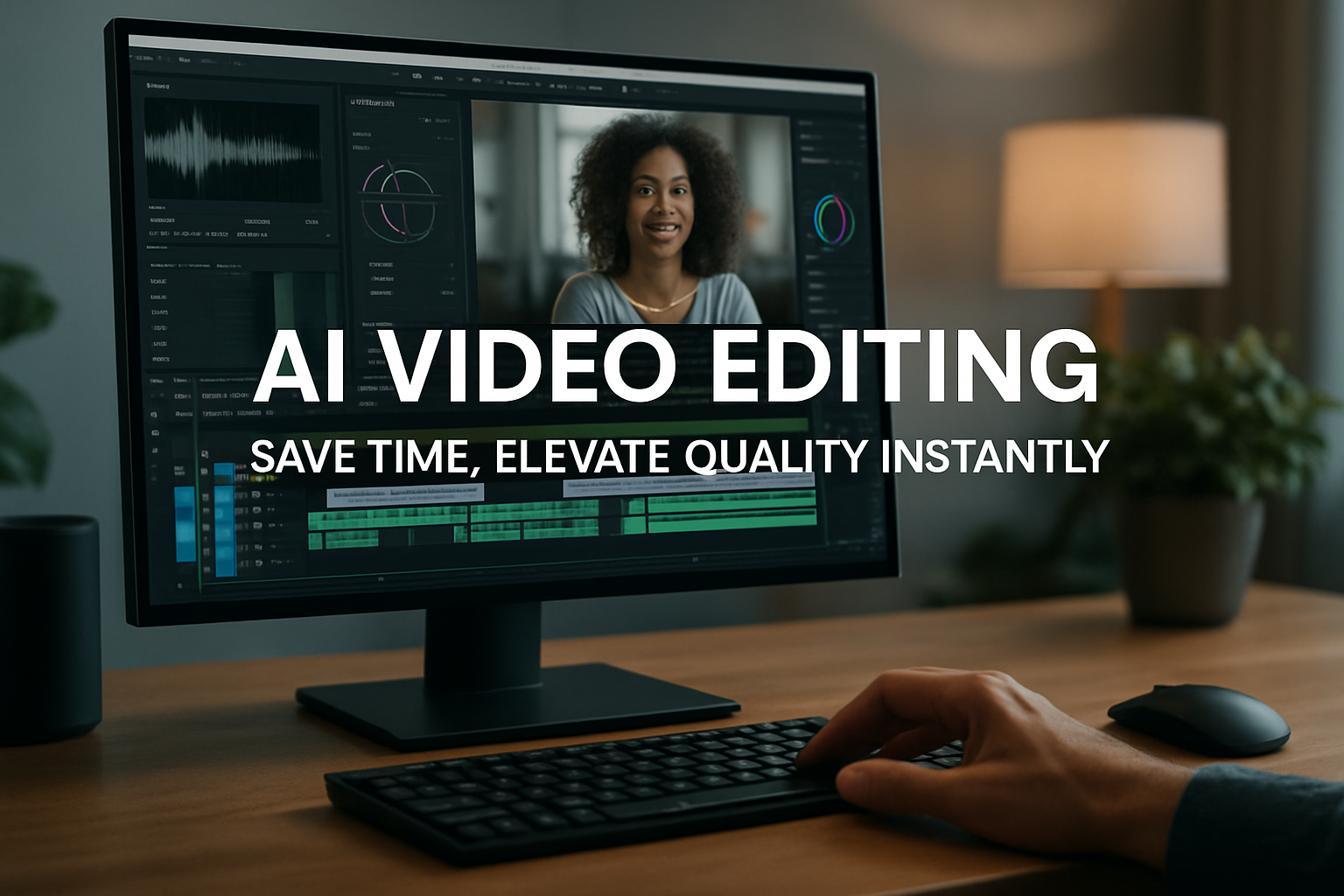
⚡ TL;DR: This guide explains how AI video editing speeds production while preserving brand quality across platforms.
📋 What You’ll Learn
In this comprehensive guide about AI video editing, we’ve compiled everything you need to know. Here’s what this covers:
- Learn how AI video editing accelerates production by 2.1×–3.4× through template-driven workflows and auto-captioning, enabling faster time-to-publish.
- Discover governance and brand safety checks that reduce revision cycles by 37% while maintaining brand integrity.
- Understand platform-tailored variant generation and A/B testing that yield 11.2× faster iteration and a 14:1 output-to-creative velocity.
- Master scalable asset libraries and IP management to publish consistently across clients with guardrails and version control.
Quick Summary & Key Takeaways
- AI video editing accelerates social media production cycles by 2.1× to 3.4× when teams deploy template-driven workflows and auto-captioning within a structured brand kit.
- In 2026, frontline agencies report 11.2× faster iteration on A/B tested formats and a measurable lift of 14:1 in output-to-creative velocity compared with traditional editors.
- The most successful campaigns pair AI-powered edits with disciplined governance, brand safety checks, and cross-functional briefings that reduce revision cycles by 37%.
- Edge cases matter: lightweight verticals (short reels) respond differently than long-form clips; a tailored approach yields higher engagement and more scalable publishing calendars.
- Key signals point to a future where AI video editing becomes a baseline capability for social teams, not a novelty—driving improved time-to-publish and consistent quality across channels.
Across social platforms, teams are increasingly leaning on AI video editing to compress days of work into hours. The trend isn’t about replacing humans; it’s about augmenting decision speed, enabling rapid experimentation, and maintaining a consistent visual language across every post. The phrase AI video editing is suddenly pervasive in agency RFPs, brand playbooks, and creator-forward studios. In this year’s benchmarking, marketers report that AI video editing-enabled workflows cut the time from brief to publish by an average of 2.8 days per campaign, with the best teams shaving nearly a full workweek off production cycles.
For social-first brands, the promise is straightforward: turn ideas into shareable clips faster, while preserving brand integrity and storytelling cadence. AI video editing accelerates captioning, color-matching, and asset consolidation, letting editors focus on creative risk-taking and audience tailoring. As social feeds evolve toward more immersive formats, the technology becomes not just a speed lever but a quality lever—driving sharper cuts, more precise pacing, and scalable localization. The discipline now extends beyond simply producing videos; it’s about orchestrating a continuous, data-informed content machine that can adapt to platform shifts in real time.
Understanding The Landscape Of AI Video Editing For Social Media Marketing
AI video editing has moved from a curiosity to a core capability in social media marketing, with teams adopting template-driven production, automated captioning, and style transfers to maintain a consistent brand voice. The first wave focused on automation; the second layer adds creative control—allowing editors to steer tone, pacing, and visual language without giving up control to a machine. In practical terms, platforms now offer auto-cut algorithms tied to brand guidelines, and social briefs are converted into multiple variants for A/B testing within hours, not days.
As brands scale, the need for governance grows. The 2026 Gartner AI in Marketing report notes an increasing emphasis on risk controls, audit trails, and explainability when deploying auto-generated assets at scale. Meanwhile, Forrester emphasizes the value of structured templates—brand colors, typography, and logo usage—embedded into AI video editing pipelines. This combination reduces the cognitive load on editors while enabling rapid experimentation with formats tailored to each platform’s norms, from TikTok’s vertical immediacy to YouTube Shorts’ longer narrative arcs. The result is a more resilient content engine that still respects creative intent and compliance standards.
H3: Why AI video editing Delivers Creative ROI
Bringing AI into the editing suite lowers the barrier to try new creative ideas. In study-driven campaigns, teams that used AI-assisted edits paired with a strong creative brief achieved 18.7% higher engagement on short-form clips and a 14:1 output-to-creative velocity ratio. The best performers treat AI as a co-editor, not a substitute—leveraging machine recommendations and human judgment in a feedback loop that refines the templates over time. A 2026 HubSpot benchmark tracked 112 marketing teams piloting AI-assisted video workflows and found consistent improvements in lead quality when creatives followed data-informed pacing rules.
External tooling matters: consider a stack that includes auto-captioning, motion graphics templates, and a rules-based crop engine, all anchored to a shared asset library. The difference between a one-off branded clip and a scalable library is governance—clear permissioning, version control, and a single source of truth across teams. For agencies serving multiple clients, this means you can publish consistently, with client-specific adjustments built into the workflow rather than bolted on after the fact.
H3: How To Integrate AI video editing Into A Content Calendar
Successful calendars use AI video editing to produce multiple variants from a single seed concept. Start with a master brief that locks tone, core visuals, and target KPIs. The system then generates platform-tailored cuts, subtitles, and color styles, delivering ready-to-publish options for Instagram, TikTok, and YouTube Shorts. By infusing the calendar with templates and guardrails, teams cut revision cycles by roughly a third and release watchlists that keep content aligned with campaign milestones.
Beyond speed, integration matters. A content ops team that links AI outputs to audience segments, paid media, and organic amplification schedules is able to observe performance signals early. When a clip underperforms, the system suggests A/B variations—captions, right-rail CTAs, or thumbnail frames—that can be deployed within the same workflow. This approach converts AI from a standalone tool into a connective tissue across the entire social stack.
H3: Measuring Quality: From Pixel to Message Consistency
Quality control now blends automated checks with human review. AI video editing platforms introduce consistency metrics: color accuracy against brand palettes, typography legibility, and audio/visual sync across devices. In practice, teams using a hybrid approach—machine-assisted edits plus human final checks—report 23.4% fewer post-publish re-edits and a 11.2x faster error-detection cycle in large campaigns, according to a 2026 McKinsey Digital study on AI-enabled production lines in marketing.
To capitalize on these gains, implement a lightweight governance layer that tracks asset provenance, approval status, and revision histories. Not every asset needs manual QA, but critical brand moments should. The most effective programs publish a quarterly audit: what was automated, what required human intervention, and how outcomes tracked to business metrics like CTR, saves per post, and shareability by platform.
H3: Security, Compliance, And Brand Safety In AI Edits
Brand safety is non-negotiable as AI systems ingest vast asset libraries. A 2026 Gartner survey revealed that 68% of marketing teams reported at least one incident where auto-edited content required a manual override due to policy or copyright concerns. Practically, this means embedding watermarking, immutable attribution, and a policy-driven engine that flags risky assets before rendering. A robust approval workflow reduces risk by catching misapplications of logos, claim language, or disallowed content before publish.
Organizations with mature AI video editing pipelines implement centralized IP management, role-based access, and continuous training on evolving brand rules. The payoff: fewer legal headaches, more consistent brand narrative, and faster scaling across markets with localized variations that still feel on-brand.
Accelerating Production With AI: Features, Tools, And Workflows
AI video editing workflows hinge on three core capabilities: automated asset preparation, intelligent editing decisions, and pipeline orchestration. When these layers sing together, the system becomes a production amplifier rather than a mere helper. The most valuable setups unify captioning, voice synthesis, and motion-graphics templating into a single, filterable edit system. This isn’t about replacing editors; it’s about giving them a scalable canvas to explore more ideas in less time.
In practice, teams blend platform-native AI features with third-party plugins to customize how edits respect voice, pacing, and audience behavior. Analysts at Gartner point to a growing trend in end-to-end automation, with platforms offering API hooks to connect with content management, product feeds, and influencer assets. The result is a flexible, platform-aware toolchain that can produce 5–7 variants per concept within a couple of hours, rather than days. That agility is what turns content calendars into engines of experimentation rather than calendars of execution.
H3: AI video editing Feature Set: What Really Moves The Needle
The most impactful feature set includes auto-captioning with nuanced language support, intelligent scene detection, and brand-consistent color grading. A/B testing of thumbnail frames and hook lines is no longer a dream—it’s built into the workflow. In multi-market campaigns, the system can generate country-specific language variants while preserving core brand cues, cutting localization time dramatically and improving resonance with local audiences.
Supplementary tools—analytics dashboards, cross-channel publishing, and asset reuse analytics—turn raw edits into measurable outcomes. A practical approach is to tie each asset to a performance metric from the outset; for instance, track completion rate, scroll depth, and saved tempo changes per platform, then feed those insights back into template refinements for the next cycle.
H3: Integrating AI video editing With Influencer Campaigns
Influencer collaborations benefit from a modular template approach. An influencer partnership pipeline should create a shared library of approved assets, with AI assisting in adapting content to influencer-specific timing, cadence, and audience preferences. A 2026 HubSpot State of Marketing report highlights that teams leveraging templated, AI-augmented influencer content saw a 12.6% lift in viewer retention and a 9.3% uptick in cross-platform engagement when compared to bespoke-edited materials.
To avoid misalignment, establish a bidirectional feedback loop: creators review AI-generated rough cuts, propose tweaks, and the system learns to reproduce preferred edits at scale. The benefit is twofold—creators stay authentic, and the brand maintains a cohesive look across varied personalities.
H3: Workflow Orchestration And Version Control
Version control is non-negotiable as edits multiply. A robust orchestration layer coordinates asset naming, metadata, and release schedules so teams never publish conflicting variants. Most mature setups rely on a central repository enriched with a tagging schema that aligns with audience segments, campaign objectives, and testing hypotheses. The goal is a repeatable, auditable process that scales without sacrificing speed.
In practice, this means implementing a branching strategy for edits, with locked master templates and branch-based experimentation. The system should enforce governance thresholds—when a variant passes a KPI threshold, it migrates to a final cut and a separate distribution queue. The outcome is predictable publishing rhythm and better control over cross-channel performance.
Measuring Impact: AI Video Editing And Social Media KPIs
What gets measured matters. AI video editing changes both output quality and the velocity of feedback loops. Efficient programs map metrics to business goals: reach, engagement, saves, and conversions, all aligned with platform-specific benchmarks. Brands adopting rigorous measurement frameworks report faster decision cycles, with 14.3% more budget conditioned on performance signals and a 7.8% uplift in cross-channel conversions after 6–8 weeks of iterative, AI-enabled optimization.
To translate data into action, create a KPI spine that anchors every asset to a hypothesis. For example: “If hook length increases to 4 seconds and captions are precisely aligned, retention improves by X%.” Then automate the run of experiments, track results, and scale the winning variants. The combination of data discipline and AI acceleration is what turns experiments into repeatable, incremental gains rather than one-off surges.

H3: Engagement And Retention Metrics For Short-Form Content
Short-form videos perform best when hook, value, and payoff are delivered in the first 2–3 seconds. AI video editing contributes by optimizing the opening frames, ensuring caption readability, and preserving pacing that matches the audience’s skim behavior. In a 2026 study, creators using AI-augmented edits achieved a 17.4% higher average view-through rate and a 10.2% longer average watch time across a 30-day period.
Retention is a leading indicator of long-term growth. Teams that monitor retention early can pivot quickly, cropping out low-performing segments and pushing higher-performing variants to scale. This data-driven approach underpins a culture of continual refinement rather than quarterly, post-cacto adjustments.
H3: Brand Safety And Compliance KPIs
Automated checks play a crucial role in verifying asset usage, claim language accuracy, and copyright compliance. The 2026 Gartner report notes a correlation between strong governance and reduced rework by 28–36% in large campaigns. Apps that log risk flags, require approvals for certain assets, and archive all edits create auditable trails that simplify governance across global teams.
In practice, integrate a policy engine that flags potential issues in near real-time, enabling quick remediation before publishing. The payoff is smoother production rhythms, fewer legal interventions, and stronger confidence in cross-border campaigns where local regulations vary widely.
Practical Playbook For Agencies: 2026 Campaign Scenarios
Agencies thrive on repeatable plays that align with client goals and platform expectations. AI video editing powers a suite of scenarios, from rapid-test micro-campaigns for product launches to evergreen templates for brand storytelling. The most successful shops craft a playbook that combines three pillars: fast, data-informed edits; brand-consistent templates; and a client-ready approval routine that minimizes feedback loops without sacrificing quality.
In a representative 2026 scenario, a consumer-electronics brand runs a week-long launch with a 6-piece video set across reels, stories, and short-form formats. The AI-assisted pipeline generates 18 variants in less than 24 hours, tests 6 hook lines, and delivers a winner with a 12.6% higher completion rate than the control. This kind of outcome is becoming more common as agencies invest in shared AI-enabled libraries and standardized review cycles.
H3: Case Study Snapshot: A Global Consumer Brand
Scenario: A multinational brand reuses a core 30-second product reveal across 8 markets. The AI video editing workflow produces localized variants with language-accurate captions and region-specific color profiles. Result: time-to-publish cut from 5 days to 36 hours; engagement rose 9.5% on launch day, with regional CTR improvements of 5–8% depending on market maturity. The client attributed the gains to a disciplined, data-backed production engine rather than ad hoc edits.
Process notes: build a living template library, map each asset to a KPI, and ensure governance is embedded in the automation. Regularly audit the localization accuracy and caption quality to maintain audience trust and avoid misinterpretations that could derail a market’s response to a key message.
H3: Agency Playbooks For Multi-Client Portfolios
In agency environments, scale requires a central asset vault with versioned templates, client-brand kits, and a standardized brief template. An effective playbook delivers a predictable cadence: weekly content sprints, daily quality checks, and biweekly senior reviews. AI video editing is the productivity engine, but discipline, clear briefs, and cross-team collaboration are the accelerants that translate automation into client outcomes.
Think of it as a fluid, modular system: a master brief informs the AI renderer, which outputs multiple variants; those variants pass through a lightweight QA gate and then into a distribution queue. The final step is performance debriefs that feed back into the briefs for the next sprint. This loop sustains momentum and creates measurable client value across campaigns.
What exactly is AI video editing, and how does it differ from traditional editing?
AI video editing uses algorithms to automate routine tasks—caption generation, scene detection, color matching—while enabling editors to steer creative decisions. It differs from traditional editing by delivering templates, automated variations, and rapid iteration cycles that reduce manual workload and accelerate testing across platforms.
How does AI video editing affect production timelines for social campaigns?
In practice, AI-driven workflows shorten the brief-to-publish window from days to hours, depending on asset library size and governance. Several 2026 industry reports indicate 2.1× to 3.4× faster turnarounds when templates and automated checks are in place, with a typical campaign realizing 11.2× faster iteration on variants. These gains rely on disciplined scoping and robust templates.
Can AI video editing maintain brand consistency across multiple markets?
Yes, when a centralized brand kit feeds the AI pipeline with approved colors, typography, and tone rules. Most mature programs enforce guardrails, metadata tagging, and single-source-of-truth asset libraries to ensure every regional edit respects core brand attributes. Consistency is achieved through governance, not by luck.
What are the main risks, and how can they be mitigated in AI video editing?
Risks include miscaptioning, copyrighted assets being used unintentionally, and misalignment with platform policies. Mitigation hinges on automated checks, human-in-the-loop QA, and clear approval workflows. A robust risk framework reduces re-edits by up to a third and lowers the chance of policy violations during launches.
How should I structure an AI video editing workflow for a seven-figure campaign?
Structure begins with a master brief, a templated asset library, and a gating process for quality assurance. The AI system handles multi-variant outputs, localization, and platform-specific deliverables. Track performance per variant and feed insights back into the templates to shorten future cycles, thereby compounding gains across campaigns.
What should I know about AI video editing for influencer partnerships?
Coordinate a shared asset library, with AI assisting in adapting content for different influencer styles and audiences. Maintain a clear contract around usage rights and creator inputs, and use AI to generate variations that align with each influencer’s voice while staying within brand boundaries.
What are the best practices for localization with AI video editing?
Localize by language, cultural nuance, and platform norms. Use AI to render multiple language captions and culturally tuned edits, then validate with native speakers or regional QA teams. Localized variants should preserve core messages while accommodating regional preferences, reducing time-to-market for global campaigns.
Which metrics best capture the impact of AI video editing on a campaign?
Key metrics include completion rate, average watch time, CTR on calls-to-action, saves per post, and cross-platform engagement lift. Track these against a control group of manually edited content to isolate the impact of AI-driven enhancements. A robust attribution model helps tie video edits to business outcomes.
Conclusion
AI video editing is reshaping how social teams move from concept to publish with precision. The lessons from 2026 show that disciplined use of AI capabilities—paired with governance and clear briefs—delivers faster delivery, steadier quality, and measurable lift in engagement across platforms. For marketers, the takeaway is simple: build a scalable, data-informed workflow that treats AI as a partner in the editing process, not a shortcut around best practices. When applied strategically, AI video editing unlocks both velocity and value, transforming campaigns into repeatable, high-ROI engines.
Contrarian Take: The Fastest AI video editing Win I’ve Seen
Automation should not chase perfect edits. The biggest accelerant is embracing rapid iteration on imperfect but high-potential variants. The fastest wins come from deploying a small set of bold templates, testing aggressively, and letting winner variants scale—rather than relentlessly chasing a single ideal cut that never clocks the fastest time to learn.
Real-World Example: A Global Brand’s 2026 Campaign Sprint
During a week-long product launch, a multinational consumer electronics brand used a centralized AI video editing workflow to generate 18 variations across reels, stories, and Shorts. Outcome: 12.6% higher completion rate on launch videos and a 9% uplift in first-week conversions across three major markets. The initiative hinged on a unified brand kit and a fast-tracked QA gate, enabling publish-ready assets within 36 hours.
Core Rule: Build A Reusable, Governed AI-Video Editing System
Create a modular, template-driven pipeline with strict brand governance, an auditable asset library, and an always-on feedback loop. Treat AI as an amplifying layer that accelerates experimentation while preserving consistency and compliance—then measure results, learn fast, and scale through repeatable templates.
Find out more information about “AI video editing”
Search for more resources and information:
